Skip to main navigation

Catalogue Blog

Suited for Change: Celebrating Women’s Success

By Suellen Lazarus, Acting Co-Executive Director of Suited for Change
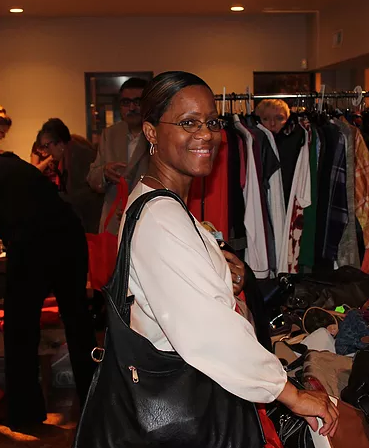
Suited 4At Suited for Change, we know that a well dressed woman is a powerful woman. We serve women who have overcome tremendous obstacles on their way to self sufficiency and are ready to re-enter the workforce. Suited for Change addresses barriers unaccounted for by other workforce programs. We provide professional attire, personalized style mentoring and job-readiness skills to women seeking financial independence. Along with professional clothing, the women who come to Suited for Change gain a renewed sense of power and confidence. Our clothing and mentoring sessions help women enter job interviews with the capacity to succeed.

The women who come to the Suited for Change boutique each day are an inspiration. They arrive at the boutique nervous, often with little confidence, and without appropriate work clothing. Some have been victims of domestic violence. Others have been incarcerated. They are single parents with young children. But all of our clients have been through job training programs and are ready for their first interview. With the help of our volunteer stylists, they are transformed to professional women ready for the workforce. To see this transformation and hear their stories, to know the path that they have traveled, that is an inspiration.
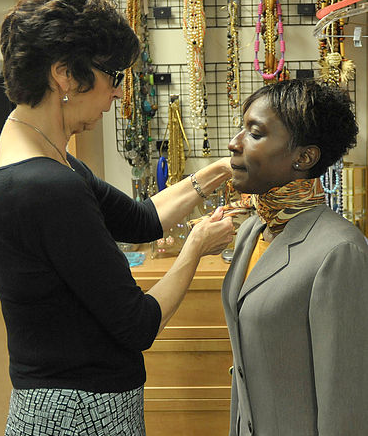
Suited 3A few weeks ago, I had the great pleasure of helping “suit” a group of women who were completing the culinary training program at DC Central Kitchen. They were about to graduate from the program and came to Suited for Change for interview clothing. I was lucky to attend their graduation breakfast and hear their stories and their extraordinary journeys. One of the women who had been through the suiting program had never held a job. She was a single parent and shy. She emerged from the boutique beautifully dressed in a black suit with a white silk blouse and pearls. At the graduation, I was delighted to learn that she had been hired at the Ritz Carlton as a pastry chef. This is just one story of many each day.

We celebrate everyday by giving women the opportunity to tell their stories, to make sure that others hear them and gain strength from them. Our goal is to share their stories so others can have optimism, hope and success.

For women preparing for interviews, and those returning after having secured a job, we would love to have greater accessibility to our programs. Many of our clients are single parents juggling beginning a new career, some find visiting our boutique during regular hours a significant barrier. We are located in an office building downtown. This has its advantages in accessibility for some but for others it can be challenging to get to. To provide our clients with additional appointment times and increase capacity, Suited for Change has begun offering weekend suiting hours and we hope to also add evening hours in 2017.

Suited for Change welcomes donations of gently used, current, pressed, clean, interview-ready clothing and accessories. Their boutique is located at 1010 Vermont Ave. NW Suite 450 Washington, DC 20005 Phone (202) 293-0351.
suited 2

Guest Post: Aspire Counseling

Mother’s Day is just around the corner and in that spirit, we welcome Aspire Counseling to the blog! Aspire Counseling is committed to meeting the mental health needs of all Montgomery County residents, regardless of income. Their programs reach out to patients at the most critical junctures in their lives: when they become parents, battle an illness, or face aging. In particular, their Healthy Mothers, Healthy Babies program offers in-home therapy to expecting and new mothers battling post partum depression. Read more about their program and how to get involved here:

When Mother’s Day is Not Happy

Sunday May 11th is Mother’s Day. If a mother, you may receive breakfast in bed, a homemade card, flowers or a text message from your college son with “Happy Mother’s Day!” And yes, mothering can be a “happy” experience. It can also be hard. Sleepless nights, tantrums, juggling schedules, laundry, negotiating, reminding, etc. are no fun and can make for, at times – an unhappy experience.

One in five women will experience an even darker side to motherhood: pre and/or postpartum depression (PPD). Low income women have triple the chance (45 – 55%) of developing PPD compared to women in middle and upper income families. Low income women are also most likely to be uninsured. Finding affordable mental health treatment is often impossible.

Aspire Counseling, a mental health non-profit organization based in Gaithersburg Maryland, runs Healthy Mothers, Healthy Babies, a community based program that provides free home based mental health therapy to low income, uninsured and under-insured pregnant women and new mothers with pre-natal and post -partum depression. Our bilingual therapists travel to the women’s homes — or wherever easiest for the mother (playground, community center). This way she does not need to find childcare, arrange transport, or leave the house which can be a completely daunting and overwhelming exercise if depressed.

Eighty five percent of the women we serve are foreign-born. Many come from countries where they would be considered “crazy” if depressed. Seventy percent have experienced physical or verbal trauma in their home country. The trauma is often horrific: repeated childhood sexual abuse, gang violence, physical abuse by parents or partners, and rape. These women have not bad choices. They have been dealt a difficult hand in life and want to rise above it — for themselves and their child.

For example, “Jane” was referred for help when she experienced symptoms of pain and paralysis after her baby’s birth and medical tests ruled out physical causes. Most of Jane’s family stayed in El Salvador when Jane came to the US. Her pregnancy was fraught with depression, bad thoughts, and remorse about having left her family behind. Jane’s feeling of paralysis spread. Her anxiety skyrocketed. Her marriage was at risk. After 13 therapy sessions, Jane’s pain and paralysis had almost entirely disappeared. She was able to use “positive self-talk” and relaxation techniques to decrease anxiety and increase her sense of control. Her marriage improved. Jane still grieves her separation from her family in Central America, but she has begun to go church, where she sees other mothers from El Salvador.

The program has been running for over twelve years and treats more than 100 low income uninsured women each year. Nancy Ebb, program founder, recalls the very first client, “She was so anxious she stayed awake all night holding her baby to make sure nothing bad happened. She, and the baby, were listless.” In 2013 the award winning program helped 111 women. One hundred of the 111 women were uninsured and would have had no source of mental health care were it not for Healthy Mothers, Healthy Babies.

Home visitation means therapists can make a real difference. Ninety percent of the women we serve through the program get better and learn tools to combat depression in the future. When a mother’s depression lifts, babies “wake up,” come alive to their surroundings, and begin to thrive. Effectively diagnosing and treating postpartum depression restores the mother-infant bond, and avoids cognitive, emotional and behavioral problems that can arise in children of depressed mothers. Mothers who are available to their babies read their signals, keep them nourished, and teach them to laugh, explore, and trust the world around them.

If you know a family member, friend, or neighbor with a new baby this Mother’s Day, take the opportunity to bring them a cooked meal, offer to run errands, or just let them know it is okay to feel tired, overwhelmed and unsure. If they need more help, are unable to sleep when the baby sleeps, continually crying and are listless, call Aspire Counseling Healthy Mothers, Healthy Babies program manager, America Caballero on (301) 978 9750.

For more information on Aspire Counseling’s Healthy Mothers, Healthy Babies program and other services, visit them online at: www.ccascounseling.org or check out their Catalogue page to get involved!

Your Giving Pledge

This week, Sara Blakely made philanthropy headlines by becoming the first female billionaire to sign the Giving Pledge – a commitment by the world’s wealthiest individuals to give a majority of their wealth to charity. It seems fitting that the first woman joins this elite group the week before Mother’s Day – a time of year to think about the important women and female role models in our lives. While eight other philanthropists also signed the Pledge this week, Blakely received the most attention – and not just for signing the pledge.

It was only in March of last year that Blakely joined the elite group of global billionaires – as well as an even smaller group of self-made female billionaires. (Only 2% of billionaires across the world who are women, the majority of whom inherited their wealth.) With those odds, it’s an achievement indeed that even one sits among the wealthiest individuals who have joined the Pledge and made a life-long commitment to philanthropy.

In reading Blakely’s pledge letter, I was inspired by the way that she recognized her privilege as a woman born into a country where girls can aspire to any career choice and have the freedom to pursue it. This is not the case in many countries around the world.

I have so much gratitude for being a woman in America. I never lose sight that I was born in the right country, at the right time. And, I never lose sight of the fact that there are millions of women around the world who are not dealt the same deck of cards upon their birth. Simply because of their gender, they are not given the same chance that I had to create my own success and follow my dreams. It it for those women that I make this pledge.

I was also inspired by her dedication to philanthropy since founding Spanx and focuses on the empowerment of women and girls across the globe.

I am committed to the belief that we would all be in a much better place if half the human race (women) were empowered to prosper, invent, be educated, start their own businesses, run for office – essentially be given the chance to soar! I pledge to invest in women because I believe it offers one of the greatest returns on investment. While many of the world’s natural resources are being depleted, one is waiting to be unleashed – women.

You don’t have to be a millionaire or billionaire like Sara Blakely to make a difference in the lives of women and girls – here in DC or around the world. Many of Catalogue’s nonprofits work to empower women – those who have been abused, exploited, ignored, or just not given the chance to thrive:

Women Thrive Worldwide advocates for programs that free women from poverty and violence.

District Alliance for Safe Housing (DASH) provides safe housing to survivors of domestic and sexual abuse.

FAIR Girls is a girls’ empowerment organization keeping girls safe from exploitation.

The Women’s Collective supports girls, women, families infected and affected by HIV/AIDS.

Girls on the Run (DC and Montgomery County) teaches girls self-esteem and healthy living through running.

The Power to Help

Not my power, but the power of the position, a power which could be used to help.

-Former First Lady, , born today in 1918. Ford was instrumental in acquiring donors for , which opened in 1982 and continues to help thousands of individuals combat addiction.

April: Sexual Abuse Awareness Month

April marks the beginning of Sexual Assault Awareness Month (SAAM). It seems as though the news has been rife with stories about high profile rape and sexual assault cases in the recently, both at home and abroad (India, Brazil, Steubenville, US military) and with the HRC report in January shining a light on DC’s own mishandling of sexual assault cases, awareness about this cause could not come at a better time. Several Catalogue nonprofits are working actively to promote awareness of sexual assault and abuse this month, through workshops, events, advocacy and awareness campaigns.

DASH will celebrate its 2013 Allies in Change Luncheon at the end of April, recognizing community partners who have made a difference in the lives of women and children facing homelessness due to domestic violence.

Men Can Stop Rape works to mobilize men to use their strength for creating cultures free from violence, especially men’s violence against women. , they are offering discounts on trainings and materials to promote knowledge about men’s role in stopping rape and sexual assault.

DC Coalition Against Domestic Violence (DCCADV) celebrated a SAAM Day of Action on Tuesday, April 2nd, mobilizing on social media and reaching out to the Justice Department and DC Mayor Vincent Gray to advocate for freedom from sexual violence.

Break the Cycle provides comprehensive dating abuse prevention programs exclusively to young people. Before SAAM started, Break the Cycle was part of the movement to pass the Violence Against Women Act (VAWA), which was signed into law by President Obama on March 7th.

Safe Shores will also celebrate National Child Abuse Prevention Month this month, and welcomes community members to several special events that teach about the complexities of child abuse (sexual, emotional/mental, and physical).

Check out the Catalogue website for more information on small, local nonprofits working to protect women and girls, and follow the latest trends and events on SAAM on social media here.

Guest Post: Women Thrive Worldwide

Women Thrive Worldwide works to create a world in which women and men work together as equals so that they, their families and their communities can thrive. They advocate for change at the U.S. and global levels so that women and men can share equally in the enjoyment of opportunities, economic prosperity, voice, and freedom from fear and violence. Their work is grounded in the realities of women living in poverty, partner with locally based organizations, and create powerful coalitions to advance the interests of the women and girls we serve.

What’s It Like to Really Live on $1 a Day? More Than 1 Billion People Can Tell You

Around the world, more than a billion people live in extreme poverty, defined as $1 or less per day. The majority of these people are women and children. They face challenges most of us can barely imagine.

Take just a few minutes to think about what you would have to give up to live on less than $1 a day.

Personally, I’d have to give up my coffee, eggs for breakfast, a mid-morning cup of tea, that bag of chips after lunch, lunch in general, my bus money to get to work — practically everything that gets me through the day. Maybe worst of all, I’d have to give up medicine that helps to keep my asthma under control.

To live on less than $1 a day, I’d have to give up nearly everything. And that’s exactly what Ritu Sharma, Co-founder and President of Women Thrive Worldwide, did on a recent trip to Sri Lanka, where she lived in a rural village with a woman, Prahansa, and her three beautiful nieces Chinthi, Kamala, and Manuka, on just $1 a day.

As the head of an organization that advocates for policies and programs that benefit women living in poverty worldwide, Ritu understands just how important it is to really know these women’s realities if she’s going be to a good advocate on their behalf. She also knows how critical it is for decision makers in Washington to hear these women’s voices. So she put her money where her mouth is and hopped a flight to Sri Lanka to live side-by-side with Prahansa, hoping to be able to understand — if only a little bit — what it’s like to live in extreme poverty.

Living with Prahansa, Ritu learned that she took the girls in when their mother left and their alcoholic father was sent to prison, and she now works every single day to make sure they’re cared for and living with family, rather than in an orphanage far away from home. To keep the family together, Prahansa’s sacrifices never end.

According to Ritu, “Prahansa stirred about 4 AM to go make her ‘rice cups’ to sell in the little market kiosk down the road from the bus stop. A teacup worth of yellow rice, a little chili and onion sauce, inside a baggie, and tied up in a neat little knot. Morning commuters would pass by, drop 10 rupees into the basket, grab a portable breakfast, and hop onto the bus into Galle. Prahansa might earn about 100-120 rupees that day, just under one dollar. Sometimes she sells them all and gets 130 rupees, if she’s lucky. Often, only a few sell. This is ALL the income she earns.”

As a result, everything from school supplies for the girls, public transportation, medical costs for Prahansa’s arthritis, clean water, household items, electricity, and clothes are up for negotiation. If she doesn’t sell enough cups, one — or most of these things — fall by the wayside.

This is just one woman’s story.

This year, Ritu will embark on two more trips to get just the slightest glimpse into what a lifetime on less than $1 a day feels like. She will meet women and their families in Honduras and Burkina Faso who, like too many, are in extreme poverty, and share their stories of survival and perseverance.

You can read the entire diary of Ritu’s trip to Sri Lanka here, read about her trip on the Huffington Post, and follow the “Living in Her Shoes: Three Countries on $1 a Day” campaign by visiting Women Thrive Worldwide’s website.


For more information on Women Thrive Worldwide, and similar Catalogue organizations, check out the following links to nonprofits working to improve the lives of women and girls (at home and abroad), as well as several Catalogue nonprofits primarily serving communities across the world.

Guest Post: Calvary Women’s Services

Today, Calvary Women’s Services provides transitional housing and significant support for 35 women a year: healthy meals, education and job readiness programs, mental health and addiction recovery services, life skills classes, and a sisterhood of support. Some women go on to Sister Circle, a permanent housing facility for women with a history of addiction; 15 work toward independent living at Pathways, the only transitional housing program in the District for homeless women with mental illness. Follow-up services ensure that graduates stay healthy and on track in their transition to independent living.

The following post comes from Calvary’s blog – check it out and learn about a great way to give back to the community through financial support. This post was written by Megan Gamble, a Development Associate at Calvary who focuses on communications and events

Changes in GED Testing Create Barriers

The GED (General Education Development) test is going through a round of changes that aim to modernize and advance the testing process, but will ultimately create barriers for those most in need of its help.

The GED tests were first created in 1942 to help returning World War II veterans transition back into civilian life; the test was later updated in 1978, 1988 and 2002 and has been taken by more than 18 million people looking to receive their high school credentials. Now, an update scheduled to begin January 2, 2014 will have far-reaching consequences for those who aspire to earn their GED.

As announced at the end of last year, all GED tests are transitioning to computer only, and anyone who has started the test will lose any uncompleted sections and have to take them over again. In the District of Columbia, the cost for the test will also go up an estimated price of $120, increased from $50.

There has been a great effort to frame these changes as forward thinking and helpful to those taking the test, but this glosses over the point that many adults without adequate computer skills, who need their GED as the next step in life, will be intimidated and discouraged from taking the test. In fact, within the Message Guide that was put out by GED Testing Services themselves, there is the acknowledgment and warning that:

“if perceive finishing the GED test as a huge challenge, they will not pursue it.”

Women who come to Calvary Women’s Services have lost their housing, may not have consistent access to healthcare and likely have not had the same access to technology that others have. We were proud to open a computer lab within our program expansion to address the later, but technology skills don’t come naturally to everyone, and a period of learning and adjustment is to be expected. Not to mention the fact that learning an entirely new process of doing something is often not a top priority for someone who is focusing on making progress with her housing, her health or her income.

When the women at Calvary set their personal goals and start to takes steps to achieve them, many of them aspire to earn their GED. Extra barriers between eager individuals and their chances for advancement will only discourage and hinder women’s opportunities to move forward and take control of their lives.

Thanks to Academy of Hope for providing resources on the GED testing changes.

Please join the conversation and share your stories of working with adult education and GED preparation, as well as your thoughts on the new changes to GED testing procedure. Will this have a positive / negative / neutral impact on the populations with whom you work?


Guest Post: Empowered Women International

Empowered Women International creates entrepreneurs and community leaders through women’s empowerment. Marga C. Fripp, the Founder and President, shares Three Reasons to Mentor a Woman, while EWI’s Media and Outreach Intern Jeremy Brandt-Vorel shares the stories of two women active in EWI’s programs. Both articles were originally published on EWI’s blog.

Why mentor a woman? Well, there are many reasons, but I want to share 3 compelling aspects that move most of our mentors.

Passion is infectious.

I often hear our mentors and even donors finding EWI’s passion for social change real and infectious. It’s true that once you meet our women entrepreneurs and experience the passion behind their work, you too will catch the bug and be transformed. We’re in the business of changing lives, but doing this without passion we wouldn’t be the same organization.

Once empowered, women give back.

It’s truly remarkable to see our immigrant or low-income women students struggling to recover from difficult life circumstances, yet working on business models that aim at social change. Income or profit is important for women. But what is most important is the change these women want to see in their communities. And their business enables them to do just that.

Mentoring is inspiring and rewarding.

We all want to feel good about being of help to someone in need. We love to support and invest in people who passionately believe in what they do. We love champions, and being part of their journeys is as rewarding as seeing them reaching the final destination.

Continue reading

Sharing Online

Did you catch “Online Mentors to Guide Women Into the Sciences” in this weekend’s New York Times?

Hundreds of prominent women working in science, technology, engineering and math will become online mentors for college students next month, part of a six-week program to encourage young women to pursue careers in STEM fields.

[…] The program has no curriculum, no exam, no grades and no credit — just a goal of connecting young students with accomplished women working in STEM fields.

[…] While women now earn more college degrees than men over all, they lag in STEM fields — particularly computer science and engineering, where they earn less than 20 percent of all undergraduate degrees.

Continue reading

New Ownership

Last week, we linked to several lessons on philanthropic work offered up by Katie Couric of ABC News and Ann Friedman of the SEED Foundation (among other women leaders) in The Atlantic. This week, MSNBC reports that “Women exert new influence on philanthropy:”

“Women are taking ownership,” said Andrea Pactor, associate director of the Women’s Philanthropy Institute at Indiana University, which has found that female-headed households are more likely to give to charity than male-headed households; and that in nearly all income groups women give more than men.

Continue reading