Skip to main navigation

Catalogue Blog

Guest Post: Playworks

October is Bullying Prevention Month. Today we’re excited to welcome Susan Comfort, Executive Director of Playworks, DC to share how their program’s strategies help create a safe, healthy environment for kids to play and be active every day!

by Susan Comfort

October is the time of year that Playworks DC Coaches at our 15 schools choose the 4th and 5th graders who are going to serve as “Junior Coaches” for the rest of the year. And we don’t always choose the star students. We purposely choose the shy kids, too, and even the bullies, who use their leadership talents in the wrong direction. Continue reading

Guest Post: DC Diaper Bank

Today’s post comes from the DC Diaper Bank, whose mission is to strengthen families by providing a reliable and adequate supply of free diapers to families in need living in the Washington, DC metropolitan area. Begun in 2010, DC Diaper Bank works with a network of 17 social service agencies to provide diapers to more than 1,700 babies and families a month. Continue reading

Guest Post: Global Kids

Today we welcome Global Kids to Goodworks! Global Kids works to ensure that urban youth have the knowledge, skills, experiences and values they need to succeed in school, participate effectively in the democratic process, and achieve leadership in their communities and on the global stage. A nationally known educational nonprofit, Global Kids combines global learning, youth development, and experiential learning strategies to work closely with underserved, at-risk youth, to improve their academics, prepare them for college and careers, and to cultivate the next generation of leaders.

Tshala Pajibo is a senior at McKinley Technology High School who plans to study literature next year in college. She joined Global Kids this summer for the Global Gateways Summer Institute and was selected to be one of the eight students who travelled to Costa Rica for a week-long service-learning trip. Tshala is a long-time resident of Columbia Heights who is active in her community and at church.

Complexities of Development: An Account by Tshala Pajibo

Here in Costa Rica we have been learning about development and some of the complexities that come with it. It really resonated with me and my experience in DC.

You see, the house that I live in- my grandma’s house – is really, really old. They have been in Columbia Heights since the Great Migration. The house, which used to be painted pink to keep it cool in the DC heat, is the family center- from family meetings to cookouts to graduation parties. Everything is held there.

It used to be in a shady neighborhood where you couldn’t go out after dark. Then it started getting better, when neighbors started looking after one another. Then the local stores started to leave. The carry-out that my brothers frequented moved because they weren’t getting business. Now there’s a strip of chain stores like Sprint, 7/11, and Target. Meanwhile, the empty houses on the block started getting fixed up, so they didn’t look weird.

That’s when my family got a letter from the DC government saying that we would have to paint our house. My grandma has always had the house painted pink to keep it cool. Now the letter said that the house was too different and was impacting the property values of other houses. It’s already hard to meet the changing prices of things, so we painted the house brown and burgundy to avoid fines.

With the increases in property tax and the cost of living, poor people are forced to move from their homes. My neighbors have changed from being families who have been here forever to people that stay for just a few years.

It’s these changes that make gentrification hard. It may not seem significant that my family had to paint over the pink paint that my grandmother loved so much, but it’s an example of how sometimes I feel like I am being made invisible in my own neighborhood. It makes me understand how some of the people in Puerto Viejo feel now that they are being move from their land for development.

——————————–

To learn more about Global Kids, please visit: http://globalkids.org/#/our-programs/washington-dc


Guest Post: Horton’s Kids

Today we’re shining a spotlight on Horton’s Kids (a recent winner of a Washington Post Charities Award and City Paper’s 2013 Best NonProfit) to find out what they’re most excited for this year and congratulate them on their 25th Anniversary!

Horton’s Kids: Celebrating 25 Years

by Kristin Frontiera

This year is an exciting one for Horton’s Kids! We are thrilled to be celebrating our 25th anniversary, an incredible milestone for our organization and the children and families we serve.

We kicked off the celebratory year over the weekend, with a dedication of the Horton’s Kids Community Resource Center to our founder, Karin Walser. This look back at the organization’s early days was a reunion of some of our earliest volunteers and the children who first joined Karin on weekend field trips! As the organization grew to include tutoring, meals, and basic needs items like shoes, coats, and glasses, Horton’s Kids served more and more children. Last year, for example, Horton’s Kids reached 676 children through tutoring, older youth programming, summer camp, and the many support services delivered at the Community Resource Center. (We blogged about the March 2012 renovation of the Community Resource Center on the Catalogue blog here!)

In addition to the many services offered in the Community Resource Center, Horton’s Kids continues to bring the children out of their isolated neighborhood into the heart of this amazing city! We are just a couple weeks into our 13th year of tutoring on Capitol Hill, and Horton’s Kids has already enrolled 120 children! With support through The Washington Post Charities, a fund of the McCormick Foundation, Horton’s Kids continues to deliver three evenings of one-on-one tutoring for children in grades K through 6.

Horton’s Kids is targeting our younger readers this year, as children need to be reading on or above grade level by third grade, or they’ll always be behind. We use a research-based intervention model, developed at the University of Virginia, that moves readers along a sequence, so they can really focus on what they need to learn, rather than what their grade level dictates. Children spend the 90-minute tutoring sessions working on reading and math skills through fun and interactive games with their dedicated volunteer tutors.

To learn more about volunteering at Horton’s Kids, visit www.hortonskids.org/volunteer. In addition to tutoring, volunteers can work with older youth on homework help, join the children on weekend field trips, and more!

SHUTDOWN: Good News and Bad (Guest Post)

by Scott Schenkelberg, Miriam’s Kitchen

The Federal government shutdown has been the talk of the town all week. And here at Miriam’s Kitchen we all want to know: how will this impact our guests?

Believe it or not, there actually is some good news: the D.C. Government found a way to stay open, and we’re incredibly grateful that they did. Through the use of the District’s “rainy day fund,” the City is expected to be funded through the next two weeks.

That means that shelters and housing will be unaffected during that period, and libraries and other government facilities where our guests often go during the days will remain open. Additionally, local outpatient health, mental health and substance abuse services that are funded by the government should remain open as well.

Federally, HUD and HHS homelessness assistance programs are considered essential, and are operating with funds from fiscal year 2012 and 2013.

That doesn’t mean it is all good news.

Certain benefits that our guests rely upon are expected to be affected. Specifically, new applications for Social Security benefits, Medicaid, food stamps and even Veterans’ pensions and disability payments might see longer than usual processing times.

And our guests are feeling the pinch in other, unexpected ways. One guest told us that his Street Sense sales had plummeted this week because Federal employees aren’t out and about during the day.

Here at MK, it is business as usual. We are open Monday through Friday, as we are year-round, providing the same high quality meals and case management services for which we are known. If you are a Federal employee who has been furloughed and is in need, please know that we are here –whether that need is for a hot meal, or to fill your time with some volunteer hours.

In the meantime, we’re standing with our guests and the rest of the nation, hoping that Congress can finally please work things out.

—————————————————————————————————

HOW HAVE YOU BEEN AFFECTED BY THE SHUTDOWN?? LET US KNOW! Email Jenn, at jhatch@cfp-dc.org

Spotlight: Reading Partners

Today we welcome Lisa Lazarus, Executive Director, Mid-Atlantic for Reading Partners to Good Works, to congratulate them on their 2013 award from the Washington Post Charities! Lisa has focused on education as a charter and traditional public school teacher, a central office administrator, and a policy practitioner. Prior to joining Reading Partners, Lisa held several leadership roles in the District of Columbia Public Schools, including Chief of Staff for the Deputy Chief of Teaching and Learning, Interim Co-Director of the Office of Secondary School Transformation, and Manager of Strategic Policy and Implementation in the Office of Out-of-School Time. Lisa graduated summa cum laude from Princeton University, earned her Master in Elementary Education from Lesley University and the Shady Hill School Teacher Training Course, and earned her Master in Public Policy at the Harvard Kennedy School of Government.

1.What motivated you to begin working with Reading Partners? What need does it fulfill and how are you (and your organization) working towards meeting it?

Reading Partners is inspiring because it provides a concrete and user-friendly way for our communities to support local schools and to address a critical problem in our city: the staggering achievement gap between students from affluent homes versus low-income ones. Reading Partners’ particular focus is on literacy and on ensuring that students from low-income communities who struggle with reading receive the individualized attention they need to succeed in school and beyond. Our model is all about recruiting and training community members to serve as a Reading Partner to a young student who will benefit from reading tutoring. My desire to join the Reading Partners team stemmed from my passion to support educational equity. I believe fully and completely that all young people deserve to develop the academic skills they need to choose their own life path, and I believe community service is an under-utilized resource in that work.

2.What exciting change or innovation is on your mind?

Front and center on my mind are all the student-focused enhancements to our curriculum this year. Reading Partners is devoting significant time, effort, and personnel to aligning our research-based curriculum to the Common Core State Standards (CCSS). This is exciting because it means our instructional materials are right on the pulse of all the latest thinking and best practices in elementary education. In addition to the CCSS project, Reading Partners is rolling out a new level of curriculum this year. The Emerging Reader level of our curriculum will focus on skill development for our students in grades K-3. Over the past few years, we have recognized the need to expand our instructional offerings in basic print concepts and phonological awareness so that our youngest readers get the exact skill reinforcement they need. I am excited to work for an organization that is willing to innovate, adapt, and create new materials in order to ensure tutors and students have exactly what they need.

3. Who inspires you (in the philanthropy world or otherwise)? Do you have a hero?

Gandhi’s reminder to “Be the change you wish to see in the world” is in my office, for that phrase reminds me to live with purpose, lead by example, and make the impact I believe our world needs. While these words guide and ground me, they also necessarily lead me to be inspired by our everyday heroes – our dedicated Reading Partners who give an hour or more of their time each week to tutor and mentor a student in our nation’s capital. Every week these men and women devote their time and energy, taking a tangible interest in a child’s life and thereby ensuring that our students have the concrete literacy skills the need to be successful. I am inspired by:

  • Sonia, a high school student who is helping to organize her friends so they too become Reading Partners.
  • Martin, a college student who takes time from his full course load to work with three students twice a week. Martin has put in additional time to learn his students’ specific needs in order to make students’ time in Reading Partners as impactful as possible. This year he is a team lead who is bringing more of his peers to the reading center each week.
  • Yogi, a working professional who is volunteering with Reading Partners for his fourth year. Yogi makes time to come into Reading Partners every week, and he rearranges his meetings to be there for his student. Noah, Yogi’s last student, said that Yogi was not just “the best teacher I ever had” but also “the best friend I ever had”.
  • Alexa, who spent over 40 hours with her student, Malachi, over the course of last year. With Alexa’s encouragement and focus, Malachi ended the year above grade level! Alexa is joining us as a Reading Partner again this year.

Each of these people, and our hundreds of other volunteers, are “being the change” they and we wish to see in the world. Our tutors demonstrate their commitment through their time in a Reading Partners reading center each week. I am incredibly inspired by and grateful for their dedication and generosity.

4.What is the single greatest challenge that your organization faces (besides finances) and how are you dealing with this challenge?

Our greatest challenge is building a volunteer movement that will result in thousands of volunteers who donate at least an hour a week to ensure that every student who needs personalized attention to learn to read receives it. We are working to build a cadre of people who identify as “Reading Partners” and who are proud to say, “I am a Reading Partner.” When this phrase becomes a household name; when churches, synagogues, youth groups, sororities and fraternities, kickball teams, book clubs, and parents decide to join the movement as Reading Partners; when together our community is addressing literacy proficiency skills by devoting an hour each week to supporting our teachers and schools by providing a young reader with one-on-one, individualized tutoring, then we will be able to ensure that all students – regardless of zip code or skin color or socioeconomic status – have access to the resources they need not only to learn to read, but also – and importantly – to read to learn.

5. What advice do you have for other people in your position?

Ask questions. Set ambitious yet attainable goals, and implement an accountability system to achieve them. Listen – to your colleagues, your volunteers, your board, your school-based stakeholders, your funders, your students’ parents and guardians, and most importantly, your clients – the students themselves. Listen also to your family and friends when they remind you, sometimes gently and other times necessarily more forcefully, to make time for yourself. Take care of yourself so you can continue to do the work you love. Take care of your body; lift weights, hike, run, swim, do yoga, bike, dance. Take care of your mind; read something that is not work-related, go to lectures, learn new things. Take care of your spirit in whatever ways are meaningful to you. Make the time to highlight and cultivate your colleagues’ talents. Learn from other executive directors who are doing incredible work in this area. Thank people. Call your grandmother. Eat nourishing food. Drink plenty of water. Laugh. Feel grateful to have a job about which you are so passionate. Revel in that even as you figure out a way to create a boundary between work and life outside of work. Have fun. And, always do what is best for our children.

6. Congratulations on receiving an award from the Washington Post charities!? What project is this grant supporting? What does this award mean to you or allow you to do?

Generous support from the Washington Post Charities helps to equip us with the resources we need to recruit hundreds of community volunteers to provide weekly, personalized reading tutoring to at least 600 students in 12 schools in 2013-14. Student enrollment in our local program has grown by 20-25% each year since our launch in 2010-11. In order to build and sustain the human capital and organizational capacity required to guarantee a high-quality learning experience for our students, we rely on local investors. The Washington Post Charities is an amazing partner to us, as they deeply understand the long-term importance of helping students to finish elementary school as confident, proficient readers. With our award from the Charities, we look forward to having the right people do the the right work to ensure that we can replicate last year’s outcomes, for 90% of target students in our program narrowed their achievement gap to their peers.


Guest Post: Hunger in America

by Billy Shore, Share Our Strength

Last week, the U.S. House of Representatives passed legislation that would cut nearly $40 billion from the Supplemental Nutrition Assistance Program (SNAP, formerly known as food stamps). The measure will kick off of SNAP at least 4 million Americans at risk of hunger and cause more than 200,000 kids to lose access to free school meals.

This legislation comes at a time when SNAP households are already preparing to see a November 1 cut in benefits that means approximately 20 fewer meals per month for a family of four. SNAP is the most powerful and effective tool we have for combating childhood hunger and has been proven to reduce poverty. Nearly 50% of SNAP participants are children, and cutting this program has major ramifications for the economy as well as the health and well-being of our kids, seniors, and working poor.

Making sure our fellow citizens have enough to eat isn’t just the right thing to do; it’s the smart thing to do. When children get the healthy food they need, they learn more at school and ward off long-term developmental and health problems. SNAP helps low-wage workers stay employed and feed their families even when working full-time at minimum wage leaves them in poverty. In short, we can’t have a strong economy with weak children and families.

You can learn more about the long-term economic ramifications of cutting SNAP by watching the video here: http://video.msnbc.msn.com/now/53052546#53052546

Share our Strength will continue to fight for the critical SNAP funding that helps families meet their children’s nutritional needs at home, and to connect families to key federal nutrition programs like summer meals and school breakfast where children learn and play. Cutting $40million from SNAP should simply not be an option.

========

Note: A few of the Catalogue nonprofits that help feed the poor and working poor include: ALIVE!, Arlington Food Assistance Center,? Food for Others, Manna Food Center, Miriam’s Kitchen and Our Daily Bread.

Spotlight: Mentors, Inc.

Today we welcome Deirdre Bagley, Executive Director of Mentors, Inc. to Good Works, to congratulate them on their 2013 award from the Washington Post Charities, a fund of the McCormick Foundation! Deirdre has been at Mentors, Inc. for about five years, with a volunteer history in youth leadership and literacy programming, and a professional history with a variety of nonprofit associations from higher education to environmental advocacy. Deirdre is at home with teen mentoring, combining her nonprofit leadership experience and personal mission interest.

1. What motivated you to begin working with Mentors, Inc? What need does it fulfill and how are you (and your organization) working towards meeting it?

I reached a point in my professional career where I felt driven to combine my professional leadership with my personal interest in working with youth, and find an organization that was well respected for their work. That led me to Mentors, Inc., which helps Washington, D.C. high school teens graduate from high school to combat the abysmal drop-out rates locally. We pair teens with a mentor to help expand their universe — internally and externally — to see and pursue what’s possible for their lives.

2. What exciting change or innovation is on your mind?

Partnerships that really work and truly enhance all partners’ capacity! We’ve begun working with the United Way and City Year at the Kelly Miller Middle School on an 8th to 9th grade transition project to improve 8th graders’ success with their new high school experience, to prevent them from joining the ranks of teens who drop out in 9th grade. City Year was already in the school with strong student, administration, and family relationships; the United Way was bringing corporate partners in as volunteer mentors, and we manage mentoring intake, matching, and support. We’re looking forward to following how these young teens do when they make the transition. Because all partners are doing what they do best and not duplicating others’ work, the project has great potential for replication.

3. Who inspires you (in the philanthropy world or otherwise)? Do you have a hero?

I don’t have heroes, but there are people who live their lives in ways I admire. Our teenagers inspire me. They persist and dream on, in spite of living in high poverty areas, attending under-performing schools, and having no family history of college-going. I admire young philanthropists who are donors and want to be connected to the causes they donate to, but don’t care to see their name displayed on a marble wall. I admire people who break out of traditional molds to do something new and positive in big and small ways. I admire children — they read the world and ask questions or provide solutions without the filter of experience, and say insightful things that adults have long lost sight of.

4. What is the single greatest challenge that your organization faces (besides finances) and how are you dealing with this challenge?

Growing our organization. Garnering enough volunteer support to meet the number of teens who want mentors; and non-mentor volunteer leadership to actively move our recruitment, giving, and programming forward.

5. What advice do you have for other people in your position?

Surround yourself with smart, positive, enthusiastic people! They help moving the world a lot less difficult and a lot more fun.

6. What’s next/coming up for you?

Next, is building our internal circle of supporters, including mentors, non-mentor volunteers, board members, and alumni (mentors and students) to help even more teens get match with mentors, graduate, persist in college, and become the people they were born to be.

7. Congratulations on receiving an award from the Washington Post Charities! What does this award mean to you?

Mentors, Inc. is a one-program operation, focused solely on matching teens with mentors to help them graduate and aspire to higher education. At least 90% of our high school seniors graduate (100% for the last two years), and at least 85% go on to college. Compared to 60% and 5-28% locally, this is amazing, particularly since we have no minimum requirement to participate in our program — only student motivation. The Washington Post Charities grant is already helping us serve more students, and advancing our 8th to 9th grade transition project which helps reduce the drop-out rate in D.C. We’re so pleased they chose our mission, and organization, to support!

Guest Post: Reach Incorporated

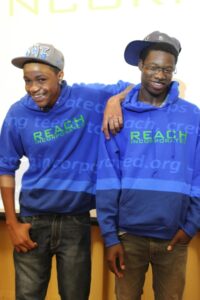
New Catalogue nonprofit, Reach Incorporated is in the business of developing readers and leaders by training teens to teach. In this guest blog post, Executive Director Mark Hecker discusses their new program, Teens Give Back, and how it not only helped to build on the progress their tutors made throughout the school year, but helped out a few other local nonprofits as well.

Emerging Philanthropists: When Teens Give Back

By Mark Hecker, Executive Director, Reach Incorporated

This summer, Reach Incorporated launched a brand new summer program. This new effort, aimed at building on the progress our tutors make during school year programming, focused on four components, including intensive reading practice, college & career investigations, and .

On July 31st, we gathered for the final exercise in the fourth component of our summer program, Teens Give Back. At the beginning of the summer, we informed our cohort of adolescents from Eastern Senior High School and Perry Street Prep PCS that they would be responsible for giving away $2,500.

For a number of weeks, our teens identified community challenges, learned about organizations addressing those challenges, and generated a list of potential grant recipients. Through ongoing research and serious conversations, our young people selected four finalists: Homeless Children’s Playtime Project (HCPP), DC Central Kitchen, Martha’s Table, and Free Minds Book Club. These decisions were made based a number of factors, including the issue addressed, the size of the organization, and the impact made.

Selecting finalists, however, was just the beginning. Our tutors were split into four teams–one for each finalist organization–and asked to write and produce pitches. These pitches, limited to 90 seconds, sought audience support at the event on July 31st. The audience votes determined the size of the grant received by each of the organizations.

From the beginning, we could tell that our young people were well prepared. The team representing HCPP didn’t even stumble as they educated and engaged the audience. During DC Central Kitchen team’s presentation, Sasha leveraged the story found on the water bottles on each table (DC Central Kitchen had catered the event). The Martha’s Table team focused on size of impact, while the Free Minds team–led by Zorita, who bravely conquered serious stage fright!–took a more personal approach. In the end, those at the event had a tough decision to make!

While the votes were counted, we had the opportunity to publicly recognize Kyare, a rising 11th grade student at Eastern Senior High. Based on his performance both in and after school, Kyare earned a promotion to Junior Staff status–the highest honor given to Reach Incorporated tutors. Kyare is just the second person to ever receive this promotion!

Smiles filled the room as we celebrated Kyare’s accomplishment, but it was time to announce our winners. Without doubt, each group wanted to win, but only one could take home the top prize. First, we announced our honorable mentions–both DC Central Kitchen and Martha’s Table received $250 grants from our kids.

The teens moved to the edge of their seats as we announced that the Homeless Children’s Playtime Project was our runner up. HCPP was thrilled to learn that they would receive a $750 grant from our young people. That left only our winners–Rashaan, Zorita, Za’Metria, and Kyare–who were thrilled to learn that they had earned a $1,250 grant for Free Minds Book Club. Free Minds staff members gathered around to get pictures taken with their adolescent advocates.

As audience members filed out of the room, our teens accepted handshakes from inspired attendees. The teens’ preparation showed in their performance. While any competition leaves some with hurt feelings, our young people were uniformly proud of the work they had done. They had, without question, learned the value of giving back. With the audience’s help, we had given birth to a group of future philanthropists.

The Homeless Children's Playtime Project team doing research

The Homeless Children's Playtime Project team doing research

The Free Minds Book Club and Writing Workshop team as they pitch the room

The Free Minds Book Club and Writing Workshop team as they pitch the room

Kyare celebrating his promotion

Kyare celebrating his promotion

If you’re interested in learning more about what happens when you give teens real responsibility for real outcomes, visit us at www.reachincorporated.org.

Guest Post: HomeAid Northern Virginia

Catalogue nonprofit HomeAid Northern Virginia is in the business of connecting local housing organizations and emergency shelters with professional homebuilders, trade partners, and sub-contractors who can offer the best renovations at the lowest costs. In this guest blog post, Executive Director Christy Eaton discusses one partnership that helped change the lives of hundreds of homeless residents. Read more about HomeAid Northern Virginia on their website, and learn more about other Catalogue nonprofits working to end homelessness here.

Public-Private Partnership Results in Renovation for Transitional Housing Program – and Brings Hope to Formerly Homeless Women and Families

By Christy Eaton, Executive Director, HomeAid Northern Virginia

The Washington, D.C., area is the ninth most expensive place to live in the U.S., with area homeowners averaging $8,798 in monthly living expenses and renters averaging $6,444 (Council for Community and Economic Research). In Virginia, 15 percent of children are living in poverty (Kids Count).

In Northern Virginia, home to some of the nation’s richest counties, nearly 1,000 children in families were identified as being homeless in 2012 (Metropolitan Washington Council of Governments).

It’s a dichotomy that HomeAid Northern Virginia has been seeking to change since we were established in 2001. We have built and renovated homeless shelters, transitional houses and other facilities throughout Northern Virginia in an effort to end homelessness in a region where many think no such problems exist. But we don’t do it alone: working with homebuilders, trade partners, government officials, and private and corporate donors, we have completed 77 projects with a retail value of nearly $12 million more than half of which was donated and has allowed service providers the ability to focus millions more of their funding on programs and services for their clients rather than on facility repairs. Together, we’ve given new hope to more than 20,000 individuals and families who are struggling to make ends meet in our region.

What is perhaps most critical to our success is our ability to develop public-private partnerships between homebuilders, non-profits and government agencies. For one of our most recent projects, a $250,000 renovation of eight apartments at the Loudoun Transitional Housing Program, we brought together the Loudoun County government, which owns the property; Volunteers of America Chesapeake, which operates the transitional housing program at the shelter; and homebuilders Miller & Smith and Winchester Homes to lead the renovation, along with 32 trade partners, suppliers and manufacturers.

I worked closely with builder captain project managers Scott Alford, operations manager, Miller & Smith, and Brian Phebus, director of production, Winchester Homes; Russell K. Snyder, president of Volunteers of America Chesapeake; and Hope Stonerook, deputy director of the Loudoun County Department of Family Services. Together, as a team, we were able to bring this project to completion, on time and on budget. It was a partnership in the truest sense of the word, and everyone throughout Loudoun County will benefit.

The homeless families and single women who live in the transitional shelter are, of course, among our greatest beneficiaries. Living in well-designed, high-quality homes returns much-needed dignity to peoples lives and boosts their self-esteem, allowing formerly homeless clients to regain confidence and long-term stability.

In fact, Scott York, Chairman of the Loudoun County Board of Supervisors, pointed out that providing housing and supportive services to homeless families and single women has had very real impact: “Since the Department of Family Services began managing the program in 2006,” he said, “more than 200 individuals have been served. In the last five years, 96 percent of the people discharged from the program have moved to a permanent housing situation.”

Upon seeing their new apartments for the first time, we heard one mom say, “I was completely shocked to see the new rooms; what a feeling to have the help my family and I are getting through this program, and to be able to come back each day to these rooms. They’re like luxury apartments, and they make me feel worth something.”

Interestingly, the Loudoun facility was, according to Hope Stonerook, a joint effort between the County and the building industry when it was first built in 1991. “Even then,” she said, “the County donated the land, and the building industry donated the materials and labor.”

Finding two Builder Captains to take on the job of renovating all eight apartments this year was not difficult: Miller & Smith has worked with HomeAid Northern Virginia on nearly 10 other projects, and Winchester Homes has served as Builder Captain for a half-dozen of our projects over the years. Both companies are committed to corporate philanthropy, have made giving back a core value, and are always among the first to step up and do whatever it takes to help us make a difference in the lives of those who need help.

For this project, all eight apartments now feature entirely new kitchens with granite countertops, seating and custom-designed tables with peninsula tops; upgraded bathrooms with custom shelving; laminate hardwood flooring in the entry and living areas; improved light fixtures, electrical systems and plumbing work; built-in storage by each bed; bedding, doors, blinds and wire closet shelving systems; and interior furnishings.

Interior design team, Carlyn and Company Interiors + Design, helped maximize functionality of the relatively small apartment spaces, focusing on maximizing storage and reconfiguring the living space. They transformed plain, small apartments into homes that residents could feel proud of.

For the $250,000 project, 87 percent of the total cost was donated by builders, trade partners and HomeAid. The remaining cost, a little more than $30,000, was paid by Volunteers of America Chesapeake. There was zero cost to Loudoun County taxpayers.

“We couldn’t have imagined the transformation made possible by this partnership,” Volunteers of America’s Russ Snyder told me, “and because of it, we can change lives and give people independence. So many people in our communities are living on the edge due to loss of employment; loss of primary support in the household; domestic violence; medical or mental health issues; and a lack of affordable housing and without fail they’ve always been thankful for whatever we could provide them. But we knew that they could have a much better experience through this renovation. They’ll be happy to come home now.”

I knew Russ was right when I heard another mom say, “I think that these rooms are really good for my children. They see these rooms, and they know that there are people who care about us. These rooms give all of us something to work toward – the people who did this for us are God’s angels.”

Smart renovations and design maximized the functionality of eight apartments at the Loudoun Transitional Housing Program, turning small, stark spaces into beautiful, welcoming ones.

Before:

After: